Annotation and Cancellation of Mortgage for Motor Vehicles 

The Land Transportation Office (LTO) also offers services like annotation and cancellation of mortgage for motor vehicles (MV). This service is particularly important as doing so will officially transfer the ownership of an encumbered motor vehicle to your name, making you the official MV owner. 

This service is particularly important in the advent of secured and credit auto loans. Nowadays, many vehicles are acquired through loans, which means a lot of them are encumbered, requiring the owner to process the annotation and cancellation of [chattel] mortgage and get their name placed as the owner of the vehicle.

annotation and cancellation of mortgage of car motor vehicle

What is ‘Certificate of Registration Encumbered’ (CRE)

Vehicles bought through the bank or via a lending company do not get a regular Certificate of Registration (CR). Instead, the owner gets a Certificate of Registration Encumbered (CRE)—an MV registration document that puts the lender as the owner of the vehicle instead of the buyer until such time that the buyer has completely repaid the loan.

The CRE is issued to prove that the motor vehicles or other items of movable personal property, or chattel, is subject to Chattel Mortgage or is used to secure the loan. It also means that the lender who released the funds needed to purchase the vehicle holds an ownership interest in it. Once the buyer has fully repaid the loan, then it is the only time that their name will be placed as the owner of the vehicle. Until then, the MV is registered in the Chattel Mortgage Register as security for the performance of an obligation. 

How to Check if a Car is Encumbered

To check if the vehicle is encumbered, you simply need to check the Certificate of Registration (CR). You can tell that the CR is actually a CRE if there is an annotation on it that says “encumbered.”

Where to File for the Annotation and Cancellation of Mortgage 

Cancellation of the Mortgage is done at the Registry of Deeds, but filing for annotation and cancellation of Chattel Mortgage can be done at the LTO. However, it can’t just be any LTO office. Changing the registration status of your motor vehicle has to be done at the originating LTO branch office, or the LTO office stated on the Certificate of Registration (CR). This means that if the CR says LTO Manila, it has to be done at LTO Manila. Going to any other LTO branch will simply make you waste your time, effort, and money.

Requirements for Filing for Annotation and Cancellation of Mortgage

Before going to the LTO, you will need to secure and prepare the following documentary requirements to avoid the hassle of having to come back to continue the process. 

The requirements are as follows:

  • Original and a photocopy of the Loan Contract
  • Chattel Mortgage Form
  • Two (2) of the following valid government-issued photo ID from the registered car owner
    • Driver’s License
    • Philippine Passport
    • Professional Regulation Commission (PRC) ID
    • SSS ID
    • GSIS ID
    • BIR ID
    • TIN ID
    • Voter’s ID
  • Taxpayer’s Identification Number (TIN)

Once these documents are ready, you may now go to the bank or the lending company who financed your loan to obtain these additional documentary requirements:

  • Original Certificate of Registration (CR) of the vehicle 
  • Latest original and photocopy of the Official Receipt (OR) of payment for the vehicle
  • Chattel Mortgage Contract duly-annotated or stamped by the Registry of Deeds (RD)
  • Original Registered Promissory Note with Chattel Mortgage
  • Two (2) copies of the Release of Chattel Mortgage 
  • Official Receipt (OR) of payment of the annotation with Registry of Deeds
  • Motor Vehicle Inspection Report (MVIR) (Motor Vehicle Inspection Report)
  • Confirmation of CR/OR (CIR-91-137) if issued by other LTO Agency

Note: You will need to have some funds at hand as you will be charged for the notarial fee to get the documents notarized before it can be released. The notarial fee ranges from P300.00 to P400.00.

How to File for Annotation and Cancellation of Mortgage for Motor Vehicles

To file for annotation and cancellation of Chattel Mortgage for your vehicle upon paying off your auto loan, then here are the steps to follow: 

Step 1. Make sure that your registration is up-to-date and that there are no pending penalties on the documents. 

Check whether the registration is up-to-date and if the vehicle is free from violations and penalties. Do not forget to also check for any discrepancies on the documents. Get the bank or the lending company to correct the documents (if needed) and confirm its availability for pick-up. Some buyers, especially for pre-owned vehicles, forget to check these things, resulting in more problems and hefty fees later on.

Step 2. Secure and prepare the documentary requirements.

Prepare the required documents and make sure you get them duplicated properly. Some documents need to be photocopied so make sure you have enough duplicates for record keeping and for submission. You will also need to get the other documents notarized, so make sure you have enough funds to do so. 

Step 3. Check the office of the Registry of Deeds (RD) where you should cancel the mortgage.

Once you have the documents prepared, proceed to the Registry of Deeds (RD) where the mortgage was registered. You should see this in the stamp on the original Registered Promissory Note with Chattel Mortgage. If it isn’t, it should also be in the original CR under the space for RD.

Step 4. Accomplish the necessary forms and submit the requirements at the designated RD.

At the RD office, you will be asked to fill out a form then submit it together with the following documents:

  • Original Registered Promissory Note with Chattel Mortgage
  • Release of Chattel Mortgage 
  • One (1) copy of your two (2) valid IDs (Driver’s License, Philippine Passport, PRC ID, SSS ID, GSIS ID, BIR ID, TIN ID, Voter’s ID).

Step 5. Before it can be processed, you will be asked to pay for some fees at the cashier—the amount of which will vary depending on the amount of your mortgage.

Processing Time for Cancellation of Mortgage

The processing time for the cancellation of the chattel mortgage may vary depending on the branch and whether the person who will sign is present at the time. That said, the processing time for the cancellation of the chattel mortgage at the Registry of Deeds could range anytime from a few hours to about two to three days.

Step 6. Once you receive the official document for the Cancellation of Chattel Mortgage, you may proceed to the designated Land Transportation Office (LTO) branch to have it removed from your vehicle’s Certificate of Registration (CR). 

Step 7. At the designated LTO branch, tell the personnel that you would like to process the cancellation of encumbrance for your vehicle.

Step 8. Proceed to the transaction counters and submit all the following documents to the Evaluator for evaluation and computation of fees. 

  • Release of Chattel Mortgage (duly stamped by the Register of Deeds) 
  • Official Receipt from when you paid for the cancellation.

Step 9. Once completed, proceed to the actual inspection of motor vehicles with duly accomplished MVIR (Motor Vehicle Inspection Report).

Step 10. Proceed to the Cashier when your name is called for the necessary fees and obtain an Official Receipt (OR).

Step 11. Surrender the Original LTO Certificate of Registration with “Encumbered” on it.

Step 12. Wait for the LTO personnel to print out a new LTO Certificate of Registration (CR) without the “Encumbered” annotation on it.

Step 13. Proceed to the Releasing Counter when your name is called to obtain the Certificate of Registration (CR), plates, stickers, and other requested documents.

Note: You will also need to pay for the new Certificate of Registration (CR) without the “Encumbered” annotation. The price ranges from P280.00 to P350.00.

Important Reminders

For your reference, here are some reminders worth taking note of. 

  • The annotation and cancellation of mortgage officially transfers the ownership of a motor vehicle acquired through a loan from the lender to the buyer. 
  • The process involves two (2) steps: cancellation of mortgage and official removal of the encumbered annotation from the LTO Certificate of Registration. 
  • The process requires the cancellation of mortgage first as it is a requirement before the encumbered annotation can be removed from the CR and a new CR can be issued.
  • There’s a separate fee for the cancellation of mortgage and for the removal of the encumbered annotation on the LTO CRE and conversion to LTO CR.
  • New MV plates, stickers, and other documents will be issued along with the LTO CR without the encumbered annotation.

Video: Annotation and Cancellation of Chattel Mortgage

Learn more about how to process the annotation and cancellation of chattel mortgage for motor vehicles by watching this video from MamiZang Vlog:

Frequently Asked Questions (FAQs)

To help you complete the annotation and cancellation of chattel mortgage for motor vehicles, here are some common questions and answers about it. 

1. What is the annotation of Chattel Mortgage?

The annotation of chattel mortgage refers to the conditional sale of personal property, in this case, a motor vehicle, as security for the payment of a loan to purchase the motor vehicle, given by a bank or a secured loan provider, under the condition that the sale shall be void upon the seller paying to the purchaser a sum of money. 

2. What does it mean to have an “encumbered” vehicle?

An “encumbered” vehicle refers to a motor vehicle purchased via a bank or a secured auto loan. This means that the ownership of the vehicle is under the lender until such time that the buyer repays the amount paid for the vehicle in full. 

3. Does LTO process cancellation of mortgage? 

No. The actual cancellation of chattel mortgage is done at the Registry of Deeds. The LTO only handles the removal of the “encumbered” annotation from the LTO Certificate of Registration.

4. How much does it cost to cancel the Chattel Mortgage?

There is no specific amount to pay for the cancellation of Chattel Mortgage as it will depend on the amount of the mortgage. Other expenses include payments for notarial services. 

5. Is the removal of the encumbered annotation in the Certificate of Registration at the LTO free?

No. There is a fee and it ranges from P280.00 to P350.00 to remove the encumbered annotation in the Certificate of Registration at the designated LTO branch. 

Summary

Annotation and cancellation of Chattel Mortgage is an important step to take especially for those who acquired their vehicle through a bank or a secured loan. This process ensures that the vehicle ownership is transferred to the buyer after paying for the loan in full. It also ensures that the motor vehicle is removed from the Chattel Mortgage Register and that it would no longer serve as the collateral for the loan taken out by the buyer. Not only that, it is also a required procedure in order to replace your LTO CRE with an LTO CR.

The process for annotation and cancellation of Chattel Mortgage involves both the procedure for cancellation of mortgage and the official removal of the encumbered annotation from the LTO Certificate of Registration. It starts with the cancellation of the mortgage first so the car owner will have the requirements for the removal of the encumbered annotation from the CR and a new CR can be issued.

Contact Information

For more information or to address your concerns or inquiries regarding the Annotation and Cancellation of Chattel Mortgage, you may reach out to LTO via the following contact information:

Land Transportation Office (LTO)

LTMS portal: Visit the LTO’s official website and fill out their Contact Us form at https://portal.lto.gov.ph/ords/f?p=PUBLIC_PORTAL:CONTACT_US:115716301949471.
Phone call: You may contact them at their telephone number (632) 922-9061 to 66.
Email: You may also send them an email at clientcare@lto.gov.ph.
LTO Text Hotline Service: You may use LTO’s nationwide SMS service for drivers and vehicle owners by typing LTOHELP and sending it to 2600
LTO office: For information, you may check the LTO branch offices closest to you.

How to Get an LTO Plate Number in Philippines

LTO license plate numbers are essential parts of every motor vehicle. It serves as a unique vehicle identifier and is issued as a set of numbers and letters on a metal plate by the Land Transportation Office (LTO) in a bid to help protect the security of both drivers and car owners. Together with your car or motorcycle’s OR and CR, the LTO license plate number serves as the vehicle’s ID which allows law enforcers to track and tell whether a vehicle has the right to be used and driven on public streets or if it’s carnapped or stolen from someone else.

LTO license plates are essential for safety and security reasons. Unfortunately, many motorists are still waiting for their plate number to be released, despite already going through the motions of securing one. Thanks to the ever-increasing number of cars hitting the roads every year, LTO continues to have a hard time catching up, which incites anger among vehicle owners given the LTO’s No Registration, No Travel policy.

how to get lto license plate number lto philippines

What is an LTO License Plate Number

An LTO license plate number refers to the set of alphanumeric characters printed on a slim metal plate and attached to the front and back side of a motor vehicle. It serves as a vehicle’s ID, proving its legitimacy and giving the motor vehicle a unique identifier in terms of registration, road violations, and compliance with government laws. 

The LTO license plate and plate number works as a unit. After all, there can’t be one without the other. It is also an imperative for drivers and car owners to ensure that they initiate the process of securing one as driving around without a license plate number is illegal. It is be flagged down anytime and to be asked to present a Certificate of Registration (CR) and Official Receipt (OR) which could lead to hefty LTO fines and a lot of trouble for transgressors.

Use of Plate Number in Philippines

A license plate number is akin to a government-owned legal identification document, but only for motor vehicles. It comes in the form of a slim piece of metal that car owners and drivers are expected to place onto the car’s front and rear bumpers for several reasons:

  • It signals to law enforcers and other motorists that the vehicle has been duly registered and has therefore earned the right to traverse public roads. 
  • It also helps the authorities monitor if every vehicle on the road is adhering to traffic rules and regulations.
  • It serves as a visible identifier.
  • With a visible number plate, motorists are assured that violators can be caught and penalized. 
  • It does away with the possibility of having law enforcers on your tail as they would usually need to chase or flag down vehicles just to check the registration and driver’s license.
  • Having a valid and legal number plate enables both drivers and aspiring car owners to avoid as many legal problems and safety problems as possible.

Qualifications

According to the Land Transportation Office (LTO), the following can get any new motor vehicle or motorcycle registered so the car owners, drivers, and operator may get the OR/CR and secure an LTO license plate number:

  • Accredited importers
  • Accredited dealers
  • Motor vehicle owners 

Requirements

Because license plate numbers may be acquired from the LTO after the initial registration of motor vehicles, hence, the process requires the same set of requirements as such.  

For a complete list of motor vehicle registration requirements, you may learn more by reading this guide on how to register your motor vehicles at the LTO

In case you wish for a unique and customized LTO license plate, then the agency also offers vanity license plates. You may be able to get the list of requirements for this one when you learn about how to secure an LTO vanity license plate. 

In case of loss, the requirements for securing a duplicate license plate is detailed in this guide on how to secure a duplicate plate. 

Procedure: How to Get an LTO License Plate Number

As mentioned earlier, the process for securing an LTO license plate number starts with the registration of a motor vehicle or a motorcycle. Along with the OR/CR, the agency also releases the car sticker, plate number, and RFID sticker, though they aren’t given out all at the same time. In fact the LTO plate numbers are clearly stated in the OR/CR, but the slim metal plate where it is embossed for visibility usually takes much longer to be released. With the current backlog for license plate numbers at the LTO, it now takes even longer before one is released. 

For the detailed procedure on how to get an LTO license plate number, then you can follow these steps:

In Person, at the LTO Office 

Step 1: Gather and prepare all the required documents for registering the type of motor vehicle you have. 

Note: There is a different set of car registration requirements for brand new cars depending on the type—whether it is Locally, Imported, Registration of Light Electric Vehicle (LEV) (AO-2006-01), Registration of Low-Speed Vehicle (LSV), Three Wheeled Vehicle, or Tax Exempt.

Step 2: Visit the nearest LTO office that processes new vehicle registrations as not all LTO branches do so.

Note: You may always call the customer hotline of the nearest LTO branch from you to ask if they process new vehicle registration and save yourself the trouble of having to go there only to find out that they don’t process car registrations.

Step 3: Once there, go to the appropriate transaction counter.

Step 4: Submit all the documentary requirements you have gathered so the LTO evaluator can assess if the documents are complete and compute the fees based on the information that they have regarding your vehicle.

Step 5: Have the MV tested for emissions and submit the Motor Vehicle Inspection Report (MVIR) containing the results.

Step 6: Pay all the necessary fees at the cashier and wait for your OR (official receipt).

Step 7: Once done, wait for your turn at the Releasing Counter to obtain the Certificate of Registration (CR), plates, and stickers.

Using the LTO LTMS Online Portal 

Here are the steps you should follow if you want to register your vehicle with the help of LTO Land Transport Management System (LTMS) portal online:

Step 1: Visit the LTO LTMS Portal online.

Step 2: Log into your account, or if you do not have one yet, register for an LTMS portal online account.

Step 3: Once done, you can then start using the LTMS portal for your specific needs with LTO, like paying off your traffic violation fines as well as your car registration and renewal fees. 

Step 4: Take note of the payment reference number (PRN) if you pay the fees online. 

Note: You may also schedule an online appointment to visit your preferred LTO branch to streamline the process for your car registration and renewal.

For a detailed guide on acquiring an LTO vanity plate, you may read about how to secure an LTO vanity license plate. 

For lost plates, the procedures are listed in this guide to securing a duplicate plate. 

Fees: How Much Does it Cost to Get an LTO License Plate Number

Since the registration procedure for motor vehicles is the same procedure for securing an LTO license plate number, then the price you will need to pay when you go through the procedure remains the same as when you register your car for the first time. It may vary depending on a few factors, but it typically costs somewhere around P1,000.00 plus additional fees for the license plate, the stickers, vehicle tags, and the inspection.

These additional fees include:

  • Metal license plate – Php 450.00
  • Stickers and tags – Php 50.00 each. 
  • Inspection fees – Php 90.00 to Php 115.00
  • Penalty fee if you fail to show up during the schedule of your car’s registration – Php 50.00

Where to Get an LTO License Plate Number

The date and location for the release of the metal plates are usually found when you verify your LTO license plate numbers online. However, it is usually at the originating LTO office where you process your initial registration, which could be at the following LTO offices:

  • New Registration Units of the Regional Offices (ROs) 
  • New Registration Units of the authorized LTO District Offices (DOs) 
  • New Registration Units of the LTO Extension Offices (EOs)
  • For exempt Motor Vehicles (MVs), Under bond, and MVs under written commitment: LTO Diliman District Office
  • For Used Imported MVs: From Subic Freeport – LTO SBMA Extension Office

How to Verify Your LTO License Plate Number

Since the LTO license plate is usually released much later than the OR/CR, you may check for the license plate number via the following channels:

By checking the OR/CR

The LTO license plate number is actually printed out on the OR/CR issued by the transacting LTO office upon completing the MV registration procedures

Via the LTO plate number verification online

A plate number verification for private vehicles can be done online, via the LTO SMS plate number verification system to see if the plate number and registration are legitimate. It is unclear if public utility jeepneys (PUJs) and other public utility vehicles (PUVs) such as taxis, tricycles, motorcycles, and trucks are included in the LTO’s verification system database. 

Via SMS

There’s an option for LTO SMS plate number verification, too, and it works regardless of network service (Globe, TNT, Smart, Sun Cellular, Dito, or Gomo). Likewise, it costs the same across all networks and is only serviceable during regular office hours, Monday to Friday, 8:00 am to 5:00 pm. 

Important Reminders

For your reference, here are some important reminders you need to keep in mind when getting an LTO license plate number:

  • The LTO license plate number is usually issued after the LTO registration procedures for motor vehicles are completed.
  • The LTO plate number can be verified through the LTO verification system online or via SMS.
  • Getting the LTO plate number verified is extremely helpful if you do not want to stay too long at a police or a military checkpoint as you can just show them the message from the LTO proving that your car is totally clear of any apprehension and records.
  • This service is also quite useful for the police force, especially if they are out to get crooks and carnappers in a checkpoint.
  • The costs for the actual license plate (P450.00) is included in the fees paid for during registration.
  • Securing a duplicate plate is possible, in cases of loss, theft, or mutilation. 

Video: How to Get a License Plate in case of Loss

Learn more about how to get a new LTO license plate in case of loss or theft, watch this video posted by Tongbits TV:

Frequently Asked Questions (FAQs)

You may also check on the common question and answers regarding how to get an LTO license plate here: 

1. Can I use a temporary plate before my license plate is released by the LTO?

Yes. You may get a temporary plate from the dealer where you purchased the motor vehicle or simply use your car’s conduction stickers as the temporary plate. Both are allowed by the LTO anyway.

2. How can I check if the LTO license plates are available for pickup?

You may use the 15-digit Motor Vehicle (MV) number on the OR/CR on the LTO verification system online or via SMS to check if the license plates are ready for release. Of course, you may always reach out to LTO directly, either by making a phone call, sending a message, or making a personal trip to the LTO office where you processed your MV’s registration.

3. Where can I find the 15-digit Motor Vehicle (MV) number?

The 15-digit Motor Vehicle (MV) number can be found in the original official receipt/certificate of registration (OR/CR). If you check your OR/CR, you will see your Motor Vehicle (MV) number on the top-left side. You will need this to run plate number checks. Once the system recognizes the status, it will tell you all the registration information as well as when and where you can pick your plate up from an LTO office, if it has not yet been released.

Summary

If you are still reading, we’re pretty sure you are no longer wondering why there’s so much clamor to speed up the release of the LTO plate numbers. After all, the license plates are necessary to drive vehicles both for identification and safety and security reasons.

Moreover, together with your car or motorcycle’s OR and CR, your LTO plate number serves as your vehicle’s unique identifier, making it easier to track in cases of accidents. 

Affidavit of Loss LTO Sample

The Land Transportation Office (LTO) usually requires an Affidavit of Loss in cases of lost driver’s license, lost conductor’s license, lost motor vehicle official receipt and certificate of registration (OR/CR), or lost number plates. Sure, it’s not all that you’ll need, but in cases of lost anything, an Affidavit of Loss is one requirement you can’t afford to be without. 

If you are at a loss on what to do or how to secure an Affidavit of Loss for use at the LTO Office, then you may learn more about how to secure or draft an Affidavit of Loss. In case you can’t, you may also use the following template, a sample Affidavit of Loss for LTO, to save you the hassle of writing one from scratch.

lto affidavit of loss sample

What is an Affidavit of Loss?

An Affidavit of Loss is a legal document declaring the loss of something, usually a license, an OR/CR, or a number plate (if the affidavit is to be used at the LTO). Regardless if the loss was due to theft, misplacement, or destruction, the Affidavit of Loss is a necessary requirement to obtain a replacement for your driver’s or conductor’s license, OR/CR, or number plates. It serves as an oath outlining that to the best of the person’s knowledge the license, OR/CR, or number plate is truly gone. 

Anytime an individual loses a document that cannot be immediately replaced with a copy, there is usually a need to file for an affidavit of loss. At the LTO, this is usually upon the loss of a license, a duplicate OR/CR, or a duplicate number plate of a vehicle. As simple as it seems, many people confuse the affidavit of loss with a written document explaining as to how the item was lost. Ultimately, while the purpose is the same, an Affidavit of Loss is much more credible, as it is usually documented officially or notarized with the help of a licensed lawyer. 

Content Format of an Affidavit of Loss

Though the LTO Affidavit of Loss may be used under different circumstances related to loss and the LTO, the affidavit itself is unchanging in its content, and must always contain the following information:

  • Title of the document
  • Personal information
    • Full name
    • Statement that affiant is of legal age
    • Civil status
    • Citizenship
    • Residence address
    • Residence Certificate Number
  • A narration of the circumstances of the loss, which includes
    • A description of the item or document lost
    • A description of how it got lost
    • The effort exerted to find it; and 
    • Your request for a replacement of the item or document lost.
  • The signature of the affiant or the person executing/signing the document.
  • The jurat or the oath or affirmation before the notary public that you have personally executed the document in the notary’s presence.

For Affidavit of Loss to be used at the LTO, the owner of the lost item must also provide information such as the make, model, and vehicle identification number for the vehicle associated with the missing documents. Though the rules and requirements regarding information required when filing an Affidavit of Loss may vary, it is always necessary to have the Affidavit of Loss notarized.

Who Can Get a Notarized Affidavit of Loss for LTO

A notarized Affidavit of Loss for LTO is something that only those who have lost LTO documents, OR/CR, license, or number plates, are required to have to be able to get duplicates or a second copy. 

Requirements for Securing an Affidavit of Loss

To get a notarized Affidavit of Loss, one must prepare the following requirements:

  • Presentation of Original and submission of one (1) photocopy of any of the following valid government issued identification card with photo and signature
    • Philippine Identification (PhilID) Card
    • Philippine passport
    • Social Security System (SSS) Card, 
    • UMID Card
    • PhilHealth ID
    • TIN Card
    • Postal ID
    • Voter’s ID
    • Barangay ID
    • PRC ID
    • OFW ID
    • Overseas Workers Welfare Administration (OWWA) ID
    • National Council of Disabled Affairs (NCDA) ID
    • Solo Parent ID
    • Voter’s Certification
    • Government Services and Insurance System (GSIS) e-Card
    • Seaman’s Book
    • Government Owned and/or Controlled Corporations (GOCC) ID, 
    • Home Development Mutual Fund (HDMF) or Pag-IBIG ID
    • Department of Social Welfare and Development (DSWD) Certification, 
    • Integrated Bar of the Philippines (IBP) ID
  • Presentation of Original Residence Certificate (cedula)
  • Money for payment of notarial fees

How to Get a Notarized Affidavit of Loss

If, somehow, you find yourself in need of an LTO Affidavit of Loss, then here are the steps on how to get one:

Step 1: Prepare three (3) copies of the affidavit document (if you can) to help save money. 

Step 2: If you can’t or you don’t mind the expenses, visit a notary public.

Step 3: With a government-issued photo ID and a residence certificate at hand, proceed to a licensed notary public office.

Step 4: Request for an Affidavit of Loss detailing when and how the driver’s license, OR/CR, or license plate was lost  (if you don’t have a prepared affidavit document).

Step 5: Provide all the details, including the exact address indicated on your lost LTO documents.

Step 6: Wait for the affidavit to be printed, signed, and notarized (if you didn’t prepare it) or signed and notarized (if you prepared the document beforehand).

Step 7: Pay the necessary fees for the notarial service.

Fees

If you are worrying about the fees associated with the Affidavit of Loss, then you really shouldn’t as it doesn’t cost much. If you come with a prepared affidavit, the price ranges from P100.00 to P400.00. If you didn’t, however, the fees range from P500.00 to P800.00 depending on the notary public that you are visiting. If you are an indigent, you may visit the Public Attorney’s Office and secure a notarized Affidavit of Loss for free. 

Sample Affidavit of Loss LTO Template Form

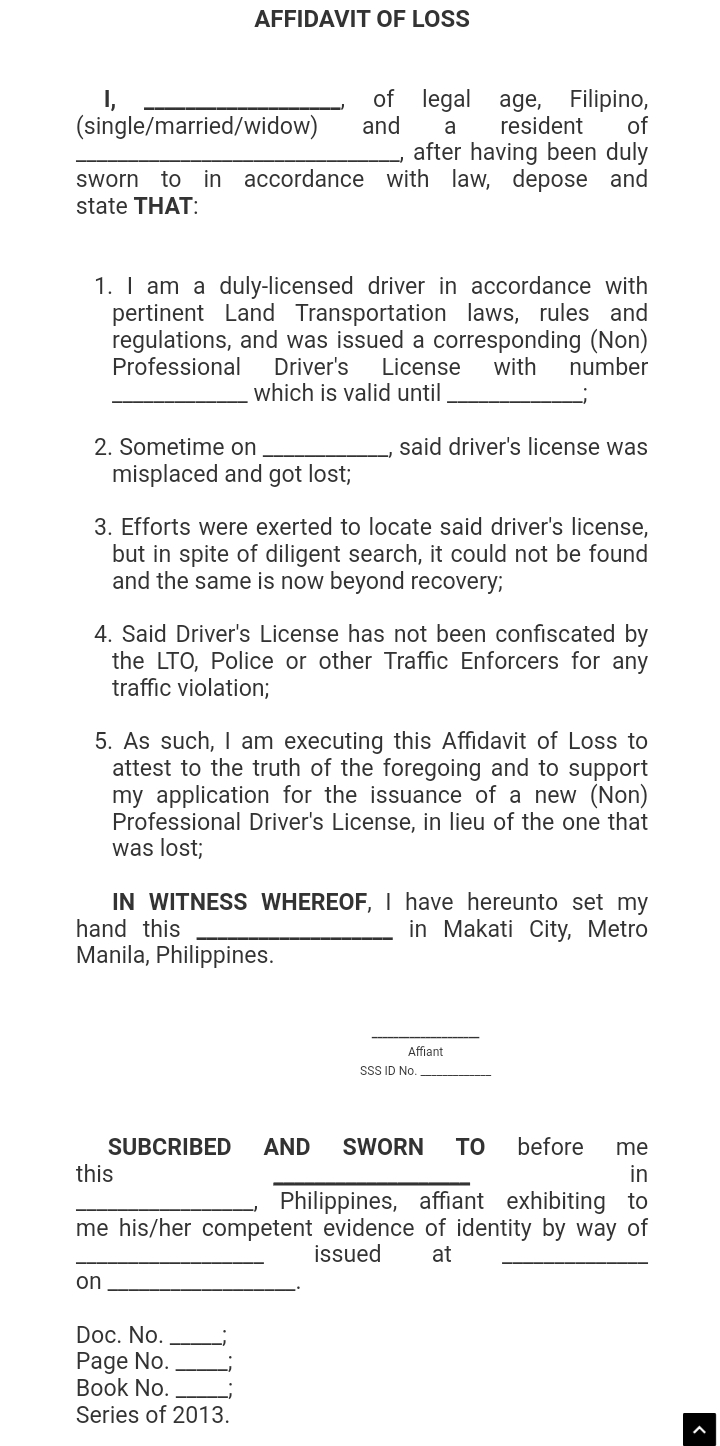
To give you an idea about how an Affidavit of Loss looks like on paper and to help you draft a copy for personal use, you may check this sample Affidavit of Loss for lost LTO driver’s license:

affidavit of loss LTO

REPUBLIC OF THE PHILIPPINES)

CITY OF MAKATI            ) S.S.

x—————————-x

AFFIDAVIT OF LOSS

 I, ___________________, of legal age, Filipino, (single/married/widow) and a resident of _______________________________, after having been duly sworn to in accordance with law, depose and state THAT:

1. I am a duly-licensed driver in accordance with pertinent Land Transportation laws, rules and regulations, and was issued a corresponding (Non) Professional Driver’s License with number _____________ which is valid until _____________;

2. Sometime on ____________, said driver’s license was misplaced and got lost;

3. Efforts were exerted to locate said driver’s license, but in spite of diligent search, it could not be found and the same is now beyond recovery;

4. Said Driver’s License has not been confiscated by the LTO, Police or other Traffic Enforcers for any traffic violation;

5. As such, I am executing this Affidavit of Loss to attest to the truth of the foregoing and to support my application for the issuance of a new (Non) Professional Driver’s License, in lieu of the one that was lost;

IN WITNESS WHEREOF, I have hereunto set my hand this ___________________ in Makati City, Metro Manila, Philippines.

Affiant.
ID No.: _________________.

SUBSCRIBED AND SWORN TO before me this ___________________ in _________________, Philippines, affiant exhibiting to me his/her competent evidence of identity by way of __________________ issued at ______________ on __________________.

Doc. No. _____;

Page No. _____;

Book No. _____;

Series of 2023.

Important Tips and Warnings

For your reference, here are some important reminders you might want to take note of:

  • Some government offices and private institutions (e.g., banks) have their Affidavit of Loss template, so it is best to check their website and use their pro forma template to save you time and money. You simply need to fill it out and bring it to the notary.
  • The Affidavit of Loss is different from a regular written statement explaining the loss, though it does give out details regarding the lost item. 
  • Securing an Affidavit of Loss usually entails making payments, but indigents may get it for free. 
  • As an Affidavit of Loss is a sworn statement, it is a must to be truthful and accurate in executing one. 
  • If the authorities find out that you have executed a false affidavit, you might face legal repercussions later on. 
  • The LTO does not have their own pro forma template for the Affidavit of Loss so you may simply make one or have the Notary Public make one for you. 
  • If you wish to save money, you might want to have an affidavit document prepared beforehand so you will only need to pay notarial services. 

Video: How to File an Affidavit if Loss at the LTO

Learn more about the fees, requirements and procedures of executing and filing an Affidavit of Loss for lost license plates at the LTO. Watch this video from Mr. BI Vlogs today!

Frequently Asked Questions (FAQs)

To learn more about executing an Affidavit of Loss for lost LTO documents or number plates, here are some common questions and answers that might help:

1. Should an Affidavit of Loss be notarized?

Yes. The Affidavit of Loss should be notarized as the affidavit only becomes a legal document if it is executed under oath. Having it notarized means you are attesting to the whole truth of the contents of your affidavit. That is the purpose of the jurat, which starts with the words “SUBSCRIBED AND SWORN TO..”

If your statement is false, you can be prosecuted for perjury. 

2. Will the notary public notarize my affidavit even if I do not have an ID?

Yes. The notary public may notarize your document if your situation falls into any of the following conditions: 

a. The notary public personally knows you;
b. The notary public does not know you, but one credible witness who is personally known to the notary public can confirm your identity;
c. If you can bring two credible witnesses who have IDs, and they can confirm your identity to the notary.

3. How much does the Affidavit of Loss cost in the Philippines?

The going rate for notarizing the affidavit of loss usually starts at P100.00. The cost varies depending on the place and the notary public itself. If they will also prepare the document, it can go up to P500.00 to P800.00 depending on the notary public. 

4. Can I get a free Affidavit of Loss?

Yes. You may also get a free Affidavit of Loss if you are indigent. Indigents can get their Affidavit of Loss notarized for free at the Public Attorney’s Office, as the latter offers notarial services to indigent persons.

To be considered indigent, your family income should not exceed P14,000.00 per month if you reside in Metro Manila, P13,000.00 for other cities, and P12,000.00 for all other places. You may also check the Legal Office or the Councilor’s Office of your city or municipality, as they sometimes offer free notarial services to their constituents.

5. How long is the validity period of the Affidavit of Loss? Does it expire?

An Affidavit of Loss has no specific expiry date, but it is only valid for the specific incident where the document is lost, so you can only use it once. It means once you obtain a replacement for the lost document and lose it again, you’ll have to execute another Affidavit of Loss and can no longer use the previous one.

6. I lost my bag containing several documents and IDs. Should I execute one Affidavit of Loss for each item/document lost, or can I execute just one Affidavit for all?

You do not need to make one Affidavit of Loss for each. One affidavit for all will suffice. 

7. I already found my lost license but I have already declared it lost and executed an Affidavit of Loss with LTO. How can I cancel or withdraw the Affidavit of Loss?

If you have already received a replacement license, then you can simply surrender the old one or just keep it until it expires. By then, it won’t matter whether or not you have two copies of driver’s license anyway.

8. Can I get an Affidavit of Loss for lost professional driver’s license at the barangay hall?

Yes. You may check the barangay for free notarial services that they sometimes offer to their constituents. In case there isn’t one available, then there’s no way to execute an Affidavit of Loss from there. 

Summary

Getting an Affidavit of Loss is a simple matter. It can be done by printing the document yourself or by simply making a short visit at a notary public’s office. Though it seems easy to make dishonest statements using this affidavit, do note that if the authorities find out that you are being dishonest when you execute your affidavit, you may face legal repercussions which might lead to hefty fines or penalties. 

error: Content is protected !!